Sunday, December 2, 2012

Conjuring Old Spirit Or New Spirit?


If one has involved in conjuration for quite some time, a frequent question that comes into mind is: “Which spirit is best; an old spirit or a new spirit?”


By old spirit I am referring to those really old spirits, perhaps over hundreds years old; or even thousands of years old. It is quite rare to find an ancient spirits around our dwelling now-a-days, unless we go to a historical site to call up an ancient spirit. New spirits on the other hand, are plenty; one can almost catch a spirit on the street.


My experience is that it is best to use a new spirit than an old one. The reason is pretty simple: the older the spirit is, the advice you will get is always out of date. For example one of my experiences is that I had an ancient Egyptian princess said to be of 4000 years old and when I asked her to solve my credit card problems; the respond I would get is: “What is a credit card?” and “What is money?”


Another example is that the longer a spirit stays in this world, the lesser can it influence our physical world. My ancient spirits can hardly do anything but to give me advices; but my new spirits were able to interfere with my radio and handy reception. Some even have the ability to topple my ritual drum and manifest physically, not to mention to show up in my dreams. And they would not ask me to explain the function of a credit card and money.


So, unless one is interested in knowing how ancient people live, it is still better to conjure up a new spirit to save you the trouble in explaining to it all the techno terms it probably hasn’t any clues on. Just imagine if you have conjured up a spirit of ancient Chinese emperor, the only thing you hear is: “I will have your head chopped if you don’t follow my order!” And how do you like it ;-)?


Conjuration is fun, instead of video games; why not give it a go J!
 

Saturday, December 1, 2012

Taking Care Of Your “Barang”


I am sure many of you have one or two “barang” or small scared items such as Merah Delima, Besi Kuning, Mustika Pearls, Leklai, etc. You must also be given instructions as how to take care of your items by the seller. Okay in that case just keep doing what you do best then. I just want to share my side of the method of taking care of these “barang”:


·       Offer the “barang” honey. You must make sure that you must use natural honey. On the contrary to common belief that only leklai feeds on honey, honey actually bring out the natural color of the “barang”.

·       Occasionally put the “barang” on fresh flowers. This is especially true for pearls of centipede; the pearls will change color if you do this consistently.

·       Keep the “barang” with a few grains of raw rice. The rice serves as a present for the watcher of the “barang”.

·         Keep the “barang” with saffron. Saffron is also used to worship Buddha’s holy relics.


 If your “barang” is genuine, you will see your “barang” change in color over time. My guru told me that only inanimate objects do not change their color or their color fades over time. You will know it whether it is an authentic item, “filling” item or a fake with the above offering methods. But it would already be too late once you discovered that your “barang” is a fake. So below are some of my personal experiences before you make the purchase:


·         The gift from spiritual world is normally small; it is seldom of gigantic size.

·       A natural “barang” does not have sharp edges; it should not look as if it is dug out or chisel out from rocks.

·       An authentic natural “barang” should not be too shinnying and normally it only has only one predominant color.

·       Observe the texture of the “barang”, it should be smooth and continuous.

·       As it is. For example, if the name is “leklai” that means “flow metal”, so you should observe smooth flow patterns; or it is not called leklai.


The signs to observe after you have purchased the “barang”:


·       A natural “barang” comes with a spirit. Unfortunately you can only find out after the purchase: strange lights, sounds or shadows in the place where you keep them.
 

Nang Kwak Vs Maneki Neko


From Thailand: Nang Kwak


From Japan: Manei Neko
 
I am not sure if Nang Kwak existed earlier in Thai first, or Maneki Neko is earlier in Japan; or which copied which. The reason is that both of them have the same hand gesture and their function is also the same. But what I do know is that Johnny and his newlywed Thai wife was having heated arguments over which should stay put in their Thai restaurant.


Nang Kwak is represented as a woman wearing a traditional Thai and sometimes Laotian traditional style dress. She also wears a golden crown on her head and is in the sitting or kneeling position. Her right hand is raised in the Thai way of beckoning a customer, with the palm of the hand pointing downwards. Her left hand is resting on her side or holds a bag full of gold on her lap. She is the patron Deity of all Merchants and Salesmen and can be seen in almost every business establishment in Thailand. Worshippers use to offer Nang Kwak soft drinks to symbolise sweet dealing on that day.


Okay. Let us go back to the story of the clashes of the titans:


Unlike most of people in Sin-Ma, once Thai started to worship a deity; they will continue throughout. The Sin-Ma people will worship a deity with full enthusiastic for the first month, if they feel that their luck is not changing for good, then on the second month; they would not put any offerings to the deity. And most probably you will see another new deity on the third month. The Thai has only one option: to believe with full faith and without doubt.


Johnny wasn’t a fan of Thai deities to begin with. But since his Thai wife insisted of worshipping Nang Kwak so even though he didn’t agree but he has found no reasons to reject his wife. Finally after a few months in operations, as his restaurant business was not progressing as has expected; Johnny wanted to try the Feng Shui method and Japanese beckoning cat, Maneki Neko instead.


Even though facing with his wife’s strong objection, Johnny persisted until his wife gave up the struggle and leave the restaurant business to Johnny alone. Well, Johnny is only a businessman; he wasn’t expert in Thai cuisine. Without his wife’s help, as expected; his restaurant was quickly losing customers and finally Johnny has to close shop for good.


If you ask me if this incident was attributed to Nang Kwak’s removal; I dare not say. I only know that running a Thai restaurant without good knowledge in authentic Thai cooking will not go very far.
     

Dream Magic & Lucid Dreaming (魂會術)


Don't use smart phone, use dream magic!
 
 
Old folks say that when we are sleeping, our soul travel out of our body. At times, we dream of enjoying good times with our friends and relatives. Upon awakening from our dreams, sometimes we still can recall part of the events.


In old times there were no telecommunication gadgets as that of current day, so the only way to meet a person one desires is through the dream. It does not matter if the person is dead or alive; living near or far. Or even due to certain circumstances that even living close together a couple was not able to meet. So dreaming becomes the best communication media at the time.


Every mortal being will dream of one thing or another. But to the ordinary people, most dreams appear as ad hoc, discrete, unorganized and even illogical. In order to have lucid dreaming, one must call for specific dream induce techniques. I have compiled some of the available techniques from east and west; new and old:


·         Self-hypnosis:

o   10 minutes before one go to bed, take out the photo of the person you want to meet; then give suggestion: “I will meet so-and-so tonight”. Repeat the exercise 10~20 times.

·         Distance hypnosis:

o   One can perform a simple exercise by telling his/her friend when they want to meet in the dreams and perform the above self-hypnosis at the designated timing.

·         Moon dream ritual:

o   Put a bowl of water under full moon and mix this water with ink to write your intention for meeting a specific person on a piece of parchment paper. Then pluck a piece of twig that is pointing to southern direction. Put the twig and paper under your pillow. It is said that you will have a dream after 3 days’ time.

·         USA dream ritual:

o   It is said that at the beginning of May festival, if a girl wanted to meet her sweetheart; then she must pluck the first red flower she come across. After that, she must smell the flower 3 times then say the below incantation: “red flower, red flower; I want to meet him tonight!”

·         Stone mortar spirit ritual:

o   This is yet another dream magic for single ladies only. The method is to get a piece of mortar and draw eyes, nose, mouth and ears on one end; while the other end is wrapped with white cloth. When this is done, burn some incense and pray to the mortar: “Lady Mortar, please show me what I want to know!”

·         Chicken egg ritual:

o   This dream magic is for everyone. Get a chicken egg and draw eyes, nose, mouth and ears on the rounded end, and then plug the narrower end of the egg in to a bowl of raw rice. Put the bowl under your bed and pray: “Egg general, please show so-and-so my heart’s desire!” 

Friday, November 30, 2012

One Root Many Variants: Reiki (靈氣)


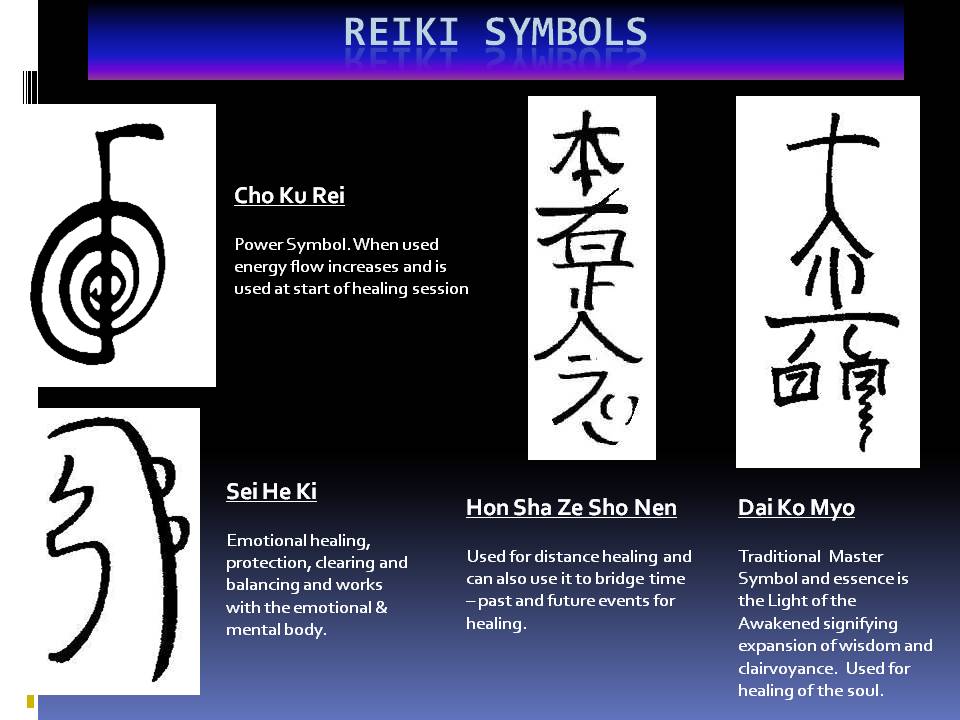
Some common Reiki symbols

 
Reiki is a spiritual practice developed in 1922 by Japanese Buddhist Mikao Usui, which has since been adapted by various teachers of varying traditions. It uses a technique commonly called palm healing or hands on healing as a form of alternative medicine.


There are three main branches of Reiki (or perhaps more):


·         Traditional Japanese Reiki

·         The Western Reiki

·         The SEA Reiki


Though differences can be wide and varied amongst the three branches and traditions, the primary difference is that Westernised forms use systematised hand-placements rather than relying on an intuitive sense of hand-positions, which is commonly used by Japanese Reiki and the SEA Reiki branches. All of the three branches commonly have a three-tiered hierarchy of degrees, usually referred to as the First, Second, and Master/Teacher level, all of which are associated with different skills and techniques.


Personally, I don't have too much excitement over Reiki, as it is no different from the Dairindo, Chinese Chigong or the SEA Tenaga Dalam practices. In fact the later three are more comprehensive than the Reiki methods, but that is only my opinion.


I have just noticed a new comer for this new millennium: “Energy Working”. Correct me if I am wrong, basically this is a catch all package in that the Reiki, chakra attunements and auto-martial arts or power dancing are repackaged and resold as a new product.


Below is a list of Reiki systems available out there, please help me to fill in the blanks if you have more to add to the list:


Ninjitsu Art of Transfix (忍術縛身法)


A ninja can produce a strong shout similar to the sound of tearing shroud towards his target as if his target is being tied and cannot move. This is the famous ninja’s art of transfix.


Below is the ritual:


First, portray three times to Buddha.


Recite the below mantra:


“Namah samanta vajranam ham.”


Perform the Kuji-kiri then recite the below mantra while performing above hand nips:


“Xin-man-sheng” (1x)

“Om Svaha” (3x)

“Na-se-ke” (1x)

“Wun” (3x)


Finally:


Invoke the below 5 Vidyarajas of Mantrayana:


East: The Trilokavijaya

West: The Yamantaka

Middle: The Acala (Fudo-myo)

South: The Vajrakuntali

North: The Vajrayaksa


If you have mastered this method, your enemies will automatically be defeated, or they will be in bewilderment and fail to carry out their agendas. This is an incredible ritual used by the Samurais and Yamabushi prists since the old days.


The Cult Of Fudo-myo (不動明王)


Fudo-myo, the wrathful aspect of Virocana.
 
 
My pal is a Fudo-myo (不動明王) fan; he has set up his modus operand according to the Fudy-myo model but replace the Kulika sword with Dewa Yakong sword. So his idea was or perhaps still is: Fudo-myo as his guardian spirit to control the Dewa Yakong. This guy is not joking: he has a few 3 feet standing Fudo-myo statues, not to mention hundreds of big and small statues in his house and shop. I call this guy and his Dewa Yakong practice: "Mr. Fuu-yoo-o & Yakong sword". Perhaps we can treat it as the New Age Fudo-myo cult.


I once asked him why is he keeping so many Fudo-myo statues and his answer was loud and clear: “Fudo-myo has saved my life from Yakong!” Though his answer was still echoing in my ears, he started to sell his Fudo-myo statue to me. I told him: “You can’t be right, this guy just saved your life and you wanna sell him!?” I never got any straight answer from this guy in return. But seriously folks, would you trust a person that is selling his savior?


Anyway, let us leave Mr. Fuu-yoo-o and his Yakong sword behind and look into the belief of Fudo-myo cult proper
 
.
 
Fudo-myo literally means “the immovable wisdom king” and is one of fierce guardian deity of Japanese Vajrayana. He is known as “Acala” in Sanskrit. In Japan, Acala became an idol of worship in its own right, and became installed as the gohonzon (本尊) or main deity at temples and outdoor shrines.


At Shingon Buddhist temples dedicated to Ācala, priests perform the Fudo-hō (不動法), or ritual service to enlist the deity's power of purification to benefit the faithful. This rite routinely involves the use of the ritual burning ceremony (護摩) as a purification tool.


Monks in Yamabushi (山伏) gear who go into rigorous training outdoors in the mountains also often pray to small Ācala statue or talisman they carry or to Fudo-myo statues that are often placed near waterfalls (a common training ground) and deep in the mountains and in caves.


Do you know that the first mudra in the famous Kuji-kiri: “Rin” belongs to the root mudra of Fudo-myo?


This is the mantra of Fudo-san (Fudo-myo):


Nômaku sanmanda bazaradan senda makaroshada sowataya un tarata kanman.

(In Japanese)


Namah samanta-vajrânâm canda mahârosana sphotaya hûm trat hâm mâm

(In Sanskrit.)


Homage to the all-pervading Vajras! O Violent One of great wrath! Destroy! hûm trat hâm mâm 

(In English)


Some of the material related to Yamabushi training: